Standing Up for Disabled Workers: TUC Disabled Workers’ Conference 2026

May 2026
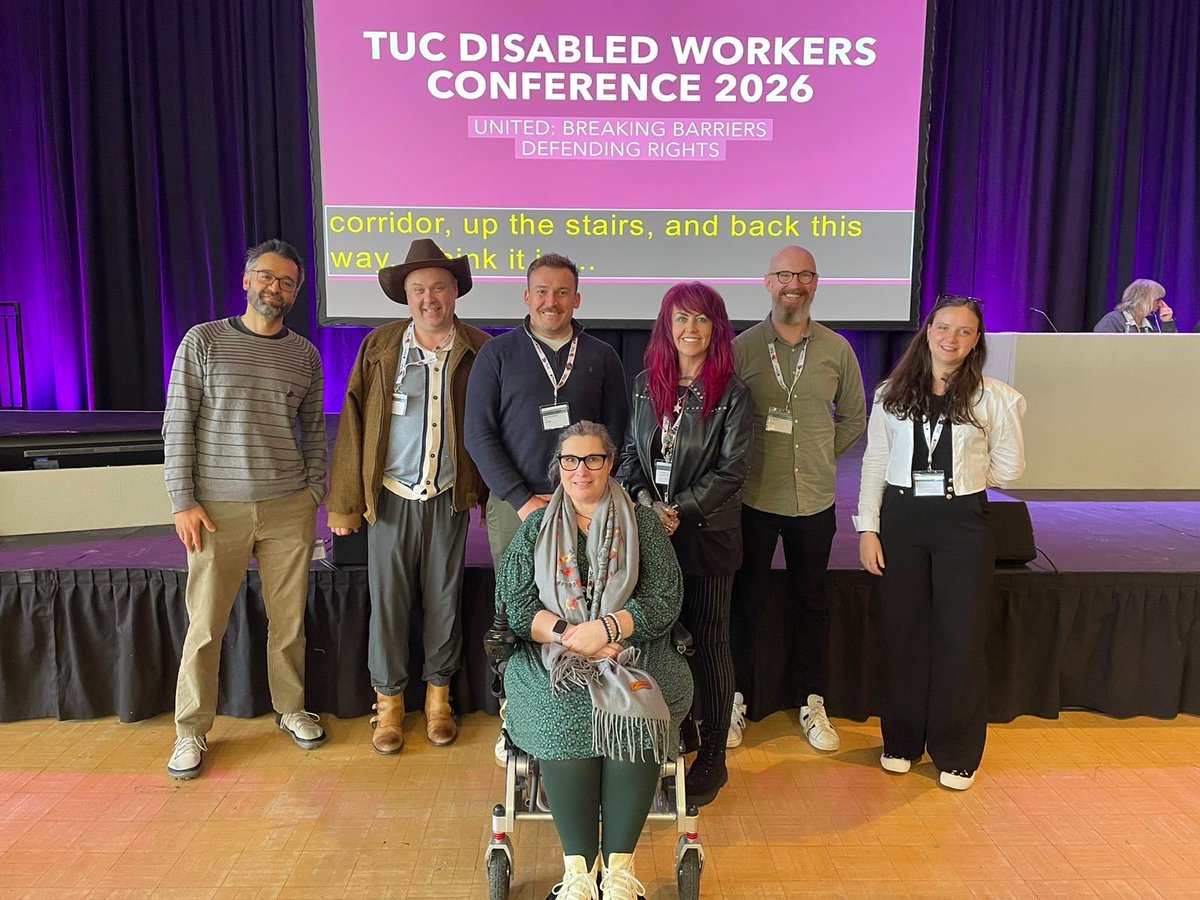
It was a privilege to attend the TUC Disabled Workers’ Conference 2026, alongside colleagues from the FDA who brought real expertise and lived experience to the floor. This year’s conference was a powerful reminder that the fight for disability equality in the workplace is urgent, unfinished, and deeply personal for millions of working people across the UK.
A Conference with Real Urgency
Across a full programme of motions, debates, and keynote contributions, delegates confronted the stark reality facing disabled workers: persistent employment gaps, a welfare system under sustained pressure, the Access to Work (AtW) and Personal Independent Payments (PIP) schemes in crisis, and workplaces that still too often treat legal obligations as optional extras.
The themes were consistent and compelling. Structural barriers, not individual limitation, keep disabled people out of work and push them out when they are in it. The social model of disability was not merely referenced; it was lived in the testimonies and arguments from the floor. And the principle of “nothing about us without us” ran through the day like a thread that refused to be cut.
Motion 5 - Support for Workers Awaiting Diagnosis and Treatment
Moved by Chloe François Oatway, FDA DHSC
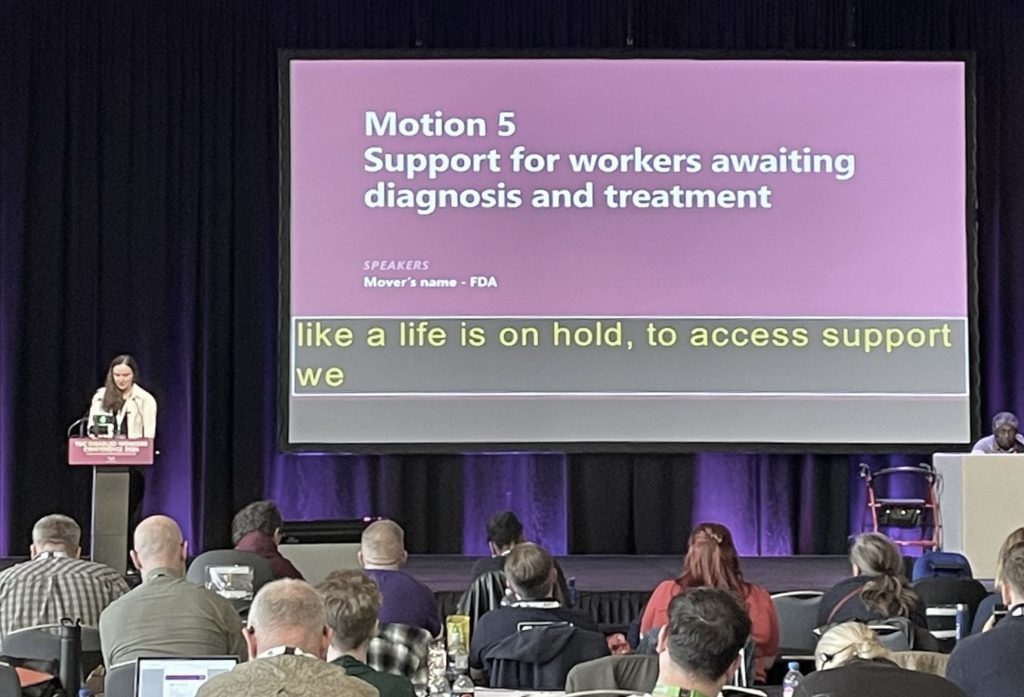
Motion 5: Chloe François Oatway, FDA DHSC, moving the motion
Chloe François Oatway, representing FDA members in the Department of Health and Social Care (DHSC), spoke compellingly to Motion 5, which addressed one of the most overlooked fault lines in disability employment: the limbo experienced by workers who are waiting for a formal diagnosis.
Workers awaiting assessment for conditions including ADHD, autism, and a range of other neurodivergent and chronic conditions can wait months or years. During that time, they face significant emotional, physical, and financial stress. And yet many employers still refuse to implement reasonable adjustments until a confirmed medical diagnosis is in hand, despite the Equality Act 2010 making clear that protection is based on the impact of symptoms, not the existence of a formal label.
Some employees are disciplined or pushed out of roles because their communication or support needs are misinterpreted as poor performance or bad behaviour, when in reality they are waiting for the system to catch up with them.
Chloe highlighted the attitudinal, cultural, and procedural barriers that compound an already difficult period: excessive workloads, disbelief from line managers, and the burden of having to “prove” a disability that has yet to receive a name. The motion called for proactive employer action, union support, and a wider cultural shift towards adjustments based on need rather than paperwork.
For HR practitioners, this motion carries a clear message: waiting for a diagnosis before acting is not a legally safe position, and it is certainly not a humane one.
Composite Motion 1 - Access to Work — Always Audiences, Never Artists
Supported by Sharon Docherty, FDA MOD
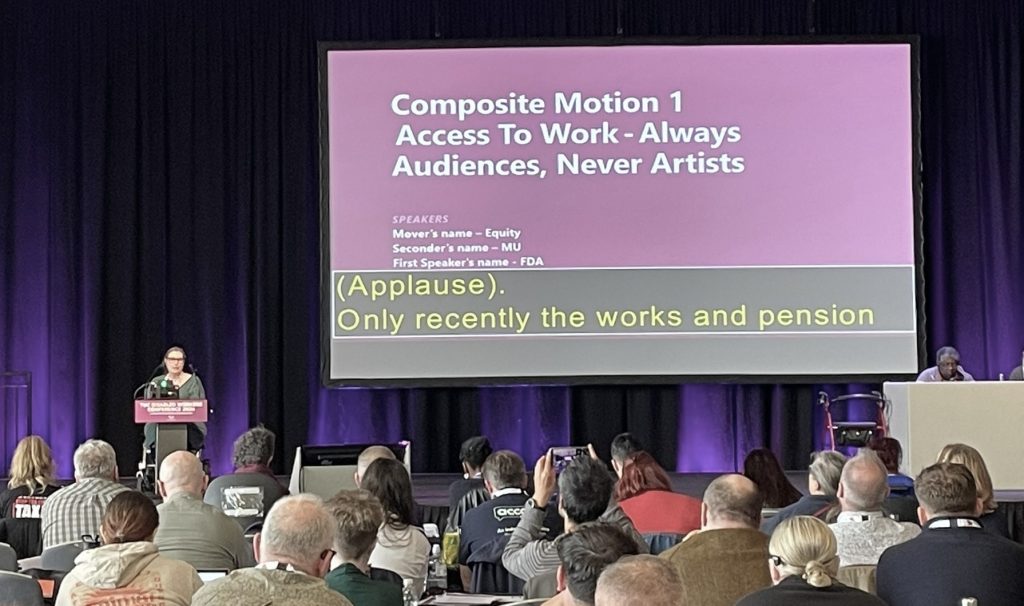
Composite Motion 1: Sharon Docherty, FDA MOD, supporting the motion
Sharon Docherty, FDA MOD, was pleased to support Composite Motion 1, which spoke directly to a crisis that is as practical as it is symbolic. The Access to Work scheme exists to fund workplace adjustments that go beyond what employers can reasonably provide: interpreters, specialist equipment, adapted transport, and more.
Work and Pensions Secretary Pat McFadden described Access to Work as a “lifeline for disabled people,” wiht demand for the scheme has more than doubled in six years:
- 66 days average processing time, up from 28
- From 76,000 applications in 2018–19 to 157,000 in 2024–25
- Backlog of around 62,000 disabled people waiting for support
The figures are damning. Demand for Access to Work has more than doubled in six years, yet the system has not kept pace. Workers wait an average of 20 months for their applications to be processed. The disparity is not only unfair; it is driving people out of the workplace entirely, causing financial hardship, reputational damage, and the loss of careers that should be thriving.
A prime example of the issues is representation within the arts and creative workforce. Only 6% of the workforce is disabled, despite disabled people representing around 25% of the population. This is not a pipeline problem. It is a structural access problem.
The motion called on the TUC to urge the Department for Work and Pensions to publish a breakdown of Access to Work processing times by sector, to commission independent research into the impact of scheme changes on disabled artists, and to release quarterly data broken down by occupation and application status. Transparency is a first step; accountability must follow.
The Access to Work Collective, founded in 2025 with two volunteers and no funding, has already mobilised thousands of members, delivered a 17,000-signature letter to Downing Street, and influenced parliamentary scrutiny. Their work is a testament to what grassroots advocacy can achieve. The Government’s announcement of 480 additional Access to Work staff is welcome, but progress must be measurable and sustained.
Motion 10 - Reasonable Adjustments in the Workplace
Supported by Alyson Taylor, FDA NHS
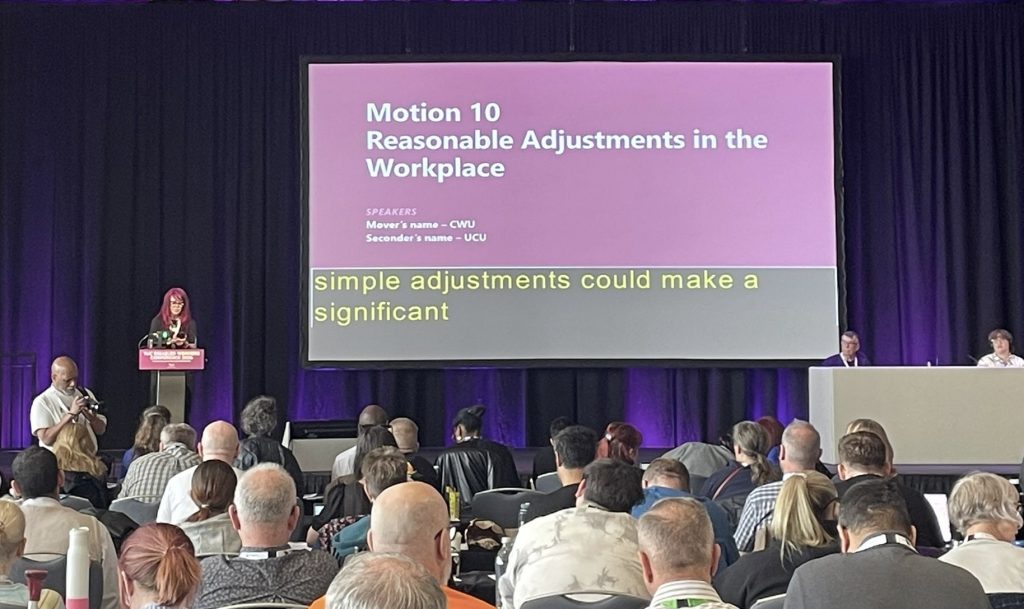
Motion 10: Alyson Taylor, FDA NHS, supporting the motion
Alyson Taylor, FDA NHS, supported Motion 10, which confronted the uncomfortable truth that reasonable adjustments — a legal right under the Equality Act 2010 — are still routinely treated as optional, withdrawn when inconvenient, and contested even when they have already been agreed.
- 3,481 disability discrimination cases, Q3 2025/26
- 99% year-on-year increase in complaints
- 34 weeks average time to resolve a case
- ~60,000 estimated tribunal backlog
The scale of employer failure captured in those numbers is striking. A near doubling of disability discrimination complaints in a single year is not a statistical anomaly. It reflects something systematic: a culture in which disabled workers are still expected to fight prolonged battles for basic accommodations, to the detriment of their health, their careers, and their dignity.
Delegates heard powerful testimonies from workers denied adjustments they were legally entitled to: careers disrupted, health deteriorated, and the emotional toll of having to justify the same need, repeatedly, to a succession of managers who treated the law as a negotiation rather than an obligation. The contrast with those supported well was equally stark — one positive example described a worker with modified duties who was able to remain in post and progress, demonstrating that good practice benefits both individual and organisation.
Simple adjustments could make a significant difference. The barriers are not financial. They are cultural, attitudinal, and managerial.
The motion proposed several constructive remedies: training all union representatives to understand and enforce the Equality Act, pressing the Government to grant the Equality and Human Rights Commission greater enforcement powers, and moving away from the self-certification model of the Disability Confident scheme. It also proposed renaming “reasonable adjustments” to “necessary adjustments” — a shift in language that reflects the mandatory rather than discretionary nature of the obligation, and that challenges the notion that meeting a legal duty is somehow going above and beyond.
Alyson’s contribution drew on the experience of NHS workers, for whom adjustments are not an abstract policy question but a daily workplace reality. A worker who receives the right support at the right time can remain productive, progress in their career, and contribute fully to their team. A worker who does not may leave the profession altogether — taking with them skills, experience, and institutional knowledge that cannot easily be replaced.
The motion’s emphasis on the social model of disability — locating barriers in workplaces and culture rather than in individuals — aligned with a consistent thread running through the whole conference. Disabled workers do not need fixing. Workplaces do.
What This Means for Employers and HR Professionals
Taken together, the motions debated at this year’s conference paint a picture of a labour market that is not yet delivering for disabled workers, and of a policy environment at a genuine inflection point. The Government’s commitments to mandatory disability pay gap reporting, reform of the Disability Confident scheme, and investment in Access to Work capacity are meaningful signals. Whether they translate into meaningful change will depend on implementation, accountability, and the extent to which disabled workers and their organisations are genuinely involved in shaping what comes next.
For employers and HR professionals, the conference offered several practical imperatives:
- Do not wait for a diagnoses before acting on a worker's adjustment needs.
- Treat reasonabl adjustments as the legal duty they are.
- Invest in manager training.
- Engage with disabled workers’ networks and union representatives as partners rather than adversaries.
The disability employment gap has barely moved in a decade. The statistics on discrimination claims are heading in the wrong direction. The AtW backlog is a national embarrassment. These are not abstract policy problems; they are the daily reality of millions of working people. This conference reminded us that solidarity, advocacy, and practical action can shift that reality. It just requires the will to do it.
At Blue Turtle HR, supporting ALL workers and building genuinely inclusive workplaces is central to everything we do. Whether you are navigating reasonable adjustment processes, reviewing your disability policies, or want to ensure your organisation is truly fit for purpose, we can help.
Get in touch or book a conversation at Blue Turtle HR