10 May 2026 - Unveiling Upward Bullying: Institutional Betrayal and Moral Injury in the Lived Experience of Public Sector Managers
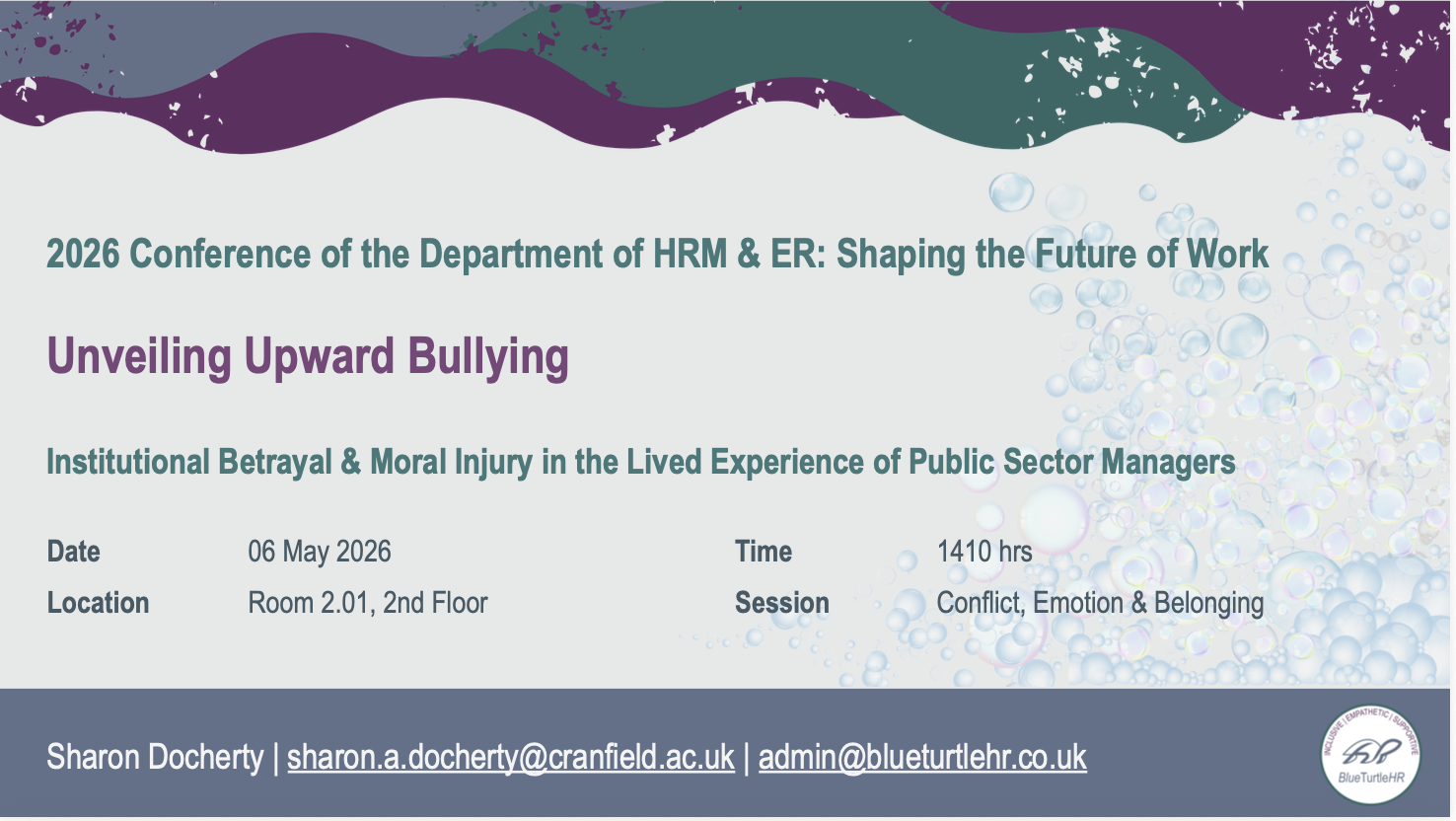
On Tuesday, 5 May 2026, I had the privilege of presenting at the 2026 Conference of the Department of Human Resource Management & Employment Relations: Shaping the Future of Work, hosted by King’s Business School at King’s College London, Bush House.
My paper, Unveiling Upward Bullying: Institutional Betrayal and Moral Injury in the Lived Experience of Public Sector Managers, sat within the Conflict, Emotion & Belonging session, and explored a phenomenon that remains one of the most under-researched areas of workplace bullying: subordinates targeting their managers.
A little context for why this matters to me. As a former Ministry of Defence civil servant now completing my doctorate at Cranfield University, my research is grounded in the public sector and in personal experience. Most workplace bullying research casts managers as perpetrators and subordinates as victims. That framing has shaped almost every survey, policy and procedure we rely on today, and it leaves the reverse pattern almost invisible.
Drawing on 12 in-depth Interpretative Phenomenological Analysis (IPA) interviews with senior MOD managers at Grade 7 and above, I traced upward bullying as a staged institutional process, not an isolated incident:
- Vulnerable entry: every manager was new to the role, often inheriting long-standing performance issues.
- Performance management as a catalyst: attempts to address underperformance, triggering targeted action.
- Malicious complaints and narrative capture: subordinates moved first, frequently invoking protected characteristics that proved unsubstantiated.
- Institutional betrayal: HR inaction, asymmetric accountability, prolonged unresolved processes.
- Moral injury: long-serving public servants found themselves unable to act in line with their professional values.
- Adaptive recovery: responses varied widely; many of my participants never returned to line management.
The finding that struck participants most forcefully was this: it was not the bullying itself that did the most serious damage. It was the institution’s response. Procedural safeguards designed to protect employees were repurposed as instruments of harm against managers who were trying to uphold them.
If we are serious about workplace wellbeing, we need a paradigm shift, institutional accountability metrics that look beyond individual perpetrators, evidentiary thresholds that guard against vexatious complaints, protected escalation pathways for managers, and onboarding processes that recognise transition as the most vulnerable moment in a manager’s tenure.
Thank you to Chiahuei Wu, Alexandra Budjanovcanin, Tara Reich and the King’s Business School team for a thoughtful and thought-provoking day, to my session chair, Amanda Jones, and to the audience members whose questions on the weaponisation of protected characteristics and generational dynamics have given me a great deal to take into the next phase of my research.
If your organisation is grappling with these questions, or if you are a manager who has lived through something uncomfortably familiar, I would be glad to hear from you.
#WorkplaceBullying #UpwardBullying #InstitutionalBetrayal #MoralInjury #HRM #PublicSector #Cranfield #KingsBusinessSchool #FutureOfWork